
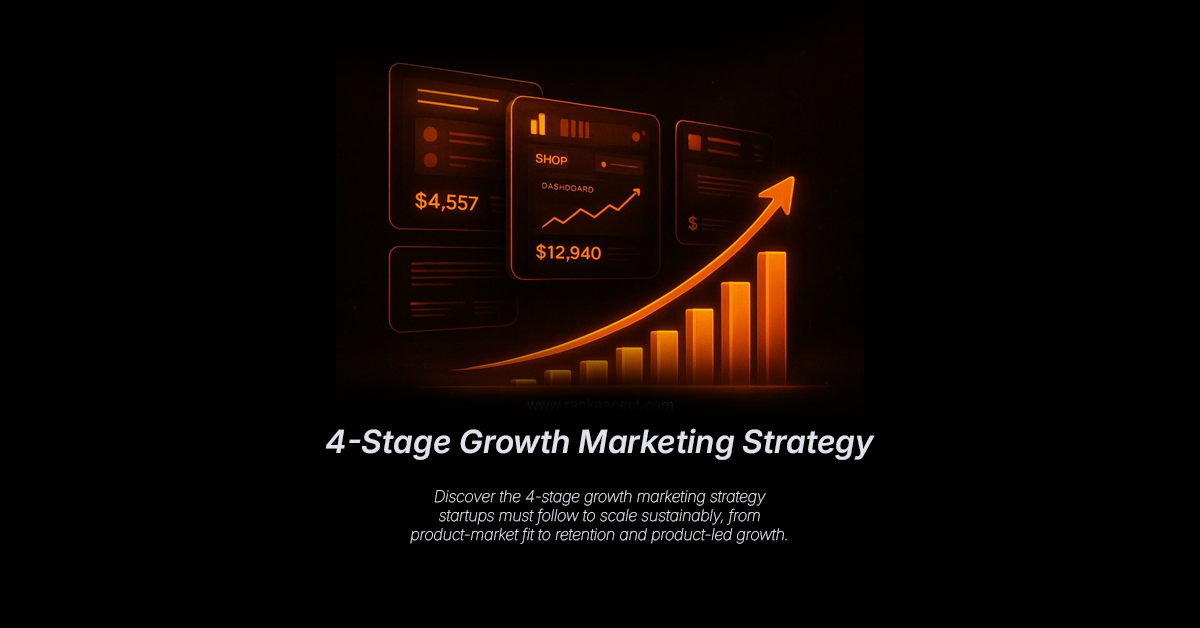
Most startups don’t fail because their ideas are bad. They fail because they chase growth before they build something people genuinely need. In the rush to acquire users, founders pour money into ads, partnerships, and campaigns without first confirming whether their product delivers real value. The result is fragile growth that depends on constant spending and collapses the moment the budget tightens.
Sustainable growth works differently. It follows a deliberate sequence of stages, each one preparing the foundation for the next. When these stages are rushed or skipped, growth turns into churn disguised as momentum. But when they are respected, startups build systems that compound over time instead of leaking value.
This four-stage growth marketing strategy is designed to help startups scale without burning trust, capital, or credibility. It is not about hacks or shortcuts. It is about building a growth engine that can survive competition, market shifts, and long-term expansion.
Table of Contents

Stage 1: Proving Real Demand Before Spending on Acquisition
The first and most important stage of growth marketing has nothing to do with marketing at all. It is about answering a single, uncomfortable question: do people truly care about what you built?
Many founders assume that downloads, signups, or waitlists mean product-market fit. In reality, those numbers often measure curiosity rather than commitment. The real signal of demand is emotional attachment. If your product disappeared tomorrow, would a meaningful percentage of users feel disappointed, or would they simply move on to something else?
This is why the Sean Ellis product-market fit test has become a standard benchmark. When fewer than forty percent of active users say they would be “very disappointed” if your product vanished, growth efforts will only accelerate churn. You are not scaling value; you are scaling dissatisfaction.
At this stage, the most valuable work is observational rather than promotional. Watching users struggle through onboarding reveals more than any dashboard ever will. Every moment of confusion is friction between the user and the value your product promises. Growth begins when that friction is removed.
One of the most powerful levers here is activation speed, which is the time it takes for a user to experience meaningful value for the first time. The faster this moment arrives, the more likely users are to stay. In today’s environment, expectations are brutal. Consumer products must deliver value within an hour. B2B tools must do so within a few hours at most. Anything longer feels like work rather than progress.
When startups redesign onboarding around this principle, referrals often increase without a single marketing campaign. Users who quickly experience value naturally talk about it. They do not need to be incentivized; they need to be impressed. This stage builds the foundation for every future growth effort because it ensures that what you are about to scale is worth scaling in the first place.
Stage 2: Finding the One Channel That Consistently Brings Qualified Users
Once real demand is validated, the next mistake many startups make is trying to grow everywhere at once. They test paid ads, SEO, influencer marketing, partnerships, and social media simultaneously. On the surface, this looks productive. In practice, it spreads attention so thin that no channel is ever mastered.
Sustainable growth comes from focus, not fragmentation. Instead of chasing every platform, startups must identify where their ideal users already gather while experiencing the problem the product solves. Growth marketing becomes easier when your message appears in places where it feels helpful rather than interruptive.
This stage is not about traffic volume. It is about activated users, meaning people who actually reach your product’s core value moment. A channel that brings fewer users but higher activation is more powerful than one that delivers thousands of signups who never engage.
Trust plays a central role here. Channels built on communities, forums, or professional groups often outperform paid media because users arrive with context and confidence. They see the product recommended by peers rather than pushed by ads. Over time, this creates a repeatable acquisition engine that is both efficient and defensible.
When a startup masters one channel deeply, it learns the language, behavior, and rhythm of its audience. This knowledge becomes an asset that competitors cannot easily copy. Only after this channel proves reliable should additional channels be explored. Growth expands outward from a core engine instead of scattering randomly in all directions.
Stage 3: Building Sharing Directly Into the Product Experience
At this point, growth marketing stops being something the marketing team does and becomes something the product itself enables. The strongest growth does not come from campaigns that begin and end. It comes from loops that repeat automatically as users interact with the product.
The most successful companies did not rely on constant advertising to grow. They designed experiences that made sharing feel like a natural extension of use. When a product creates something useful, beautiful, or meaningful, people want to show it to others.
This pattern can be seen clearly in products like Notion, where sharing a workspace is part of collaboration rather than a referral request. Dropbox made file sharing its core function, turning every user into a distribution point. Slack grew inside organizations because teamwork itself required inviting others. Duolingo transformed personal progress into something people wanted to celebrate publicly.
What these products share is timing and context. Sharing happens at moments of success, achievement, or collaboration. It does not feel forced. It feels helpful. The user benefits, and so does the person receiving the invitation.
Poorly designed referral systems do the opposite. When users are required to share in order to unlock features, trust erodes. Growth becomes transactional instead of relational. The most effective sharing mechanisms are optional, effortless, and clearly beneficial to both sides.
When done well, product-driven sharing compounds. Each new user has the potential to bring in more users simply by continuing to use the product as intended. This transforms growth from a constant expense into a natural outcome of value creation.
Stage 4: Strengthening Relationships With Existing Users to Multiply Growth
The final stage is the most neglected and the most powerful. Many startups obsess over acquiring new users while quietly losing the ones they already have. They celebrate total signups while ignoring churn. This creates an illusion of progress that masks a broken system.
True growth is measured by how much value is retained and expanded among existing users. This is why Net Revenue Retention has become one of the most important metrics for modern startups. When revenue from current customers grows faster than revenue lost from churn, the business can scale even without new acquisition.
This stage requires a shift in mindset. Users are no longer treated as completed transactions but as ongoing relationships. Power users, those who engage deeply and consistently, are signals of where value truly exists. These users should be invited into conversations, feedback loops, and communities where they help shape the product’s future.
Human recognition plays a critical role here. Personalized outreach, genuine appreciation, and thoughtful communication build emotional loyalty that competitors cannot easily disrupt. Discounts can be copied. Relationships cannot.
When startups invest in existing users, expansion happens naturally. Customers upgrade plans, recommend the product, and defend it publicly. Growth becomes a shared journey rather than a one-sided transaction. Over time, this stage transforms customers into partners and advocates who reinforce every other stage of the growth system.
Conclusion: Growth Marketing Strategy Is a System, Not a Shortcut
Sustainable growth is not the result of clever tactics or viral tricks. It is the outcome of a structured process built on value, focus, product experience, and relationships.
The four stages work together as a single system. Real demand creates the foundation. A focused channel brings in the right users. Product-driven sharing multiplies reach. Strong relationships turn customers into advocates. Skipping any stage weakens the entire structure.
Startups that respect this sequence build companies that last. Those that ignore it chase numbers that disappear as quickly as they arrive.
Growth marketing strategy, at its best, is not about making noise. It is about making something so useful that people stay, share, and believe in it.
The most important question now is not how fast your startup can grow, but which stage you are truly in today and whether you are ready to master it before moving forward.
Frequently Asked Questions (FAQ)
What is a 4-stage growth marketing strategy for startups?
A 4-stage growth marketing strategy is a structured approach that helps startups scale in a sustainable way instead of relying on random tactics. It begins with validating real user demand, then identifying the most effective acquisition channel, followed by building sharing into the product experience, and finally strengthening relationships with existing users. Each stage builds on the previous one, ensuring that growth is based on value creation rather than short-term spikes in traffic or signups.
Why should startups focus on product-market fit before marketing?
Marketing a product that users do not truly need only accelerates churn and wastes resources. Product-market fit ensures that people genuinely find value in the solution. When users experience meaningful benefits quickly, they are more likely to stay, recommend the product to others, and become long-term customers. Without this foundation, even the best marketing campaigns will fail to produce sustainable growth.
How do startups choose the right growth channel in Stage 2?
The right growth channel is where potential users already spend time discussing or experiencing the problem your product solves. Instead of testing every platform, startups should focus on one channel that consistently brings activated users rather than just traffic. This could be a community, forum, professional network, or niche social group. Mastering one channel creates a reliable acquisition engine before expanding to others.
What does “product-led growth” mean in Stage 3?
Product-led growth means designing the product so that sharing and adoption happen naturally through normal usage. Instead of relying only on ads or campaigns, the product itself encourages growth through collaboration, achievements, or useful outputs that users want to share. When sharing feels helpful rather than forced, it creates growth loops that compound over time.
Why is retention more important than acquisition in Stage 4?
Retention determines whether growth is stable or fragile. Acquiring new users is expensive, but keeping existing users and expanding their engagement generates long-term revenue and trust. High retention means customers are satisfied and see ongoing value. It also increases lifetime value and turns users into advocates who help bring in new customers organically.
Can startups skip any of the four stages to grow faster?
Skipping stages often leads to short-term spikes followed by long-term failure. For example, scaling acquisition before validating demand creates high churn, and focusing on referrals before retention weakens trust. Each stage exists for a reason, and growth becomes sustainable only when startups move through them in sequence. Speed comes from clarity and focus, not from rushing the process.
How long should a startup stay in each growth stage?
There is no fixed timeline because each startup, industry, and market is different. Some may spend months validating product-market fit, while others progress faster. The key is not time but proof. A startup should only move to the next stage when the current one shows clear results, such as strong activation, consistent user acquisition from one channel, or high retention from existing customers.